Since graduating with my MBA from the University of La Verne this year, people have been asking me two repeating questions: 1) Can you help me with my business idea, and 2) What did you learn in college?
I am definitely not alone in terms of receiving a graduate degree and having people ask me if I can use my acquired knowledge to help them…[fill in the blank]. Law School graduates are often asked if they can help with x, y, z legal issue and MBAs are often asked if they can help with business ideas. My last post (When A Hobby Becomes A Business) answers the first questions because, yes, I am more than willing to help people with their business ideas provided I see value in their endeavor and my company receives an ownership stake…and it does not interfere with my personal projects.
But, what did I actually learn in college? To be honest, that’s not as straightforward as it seems.
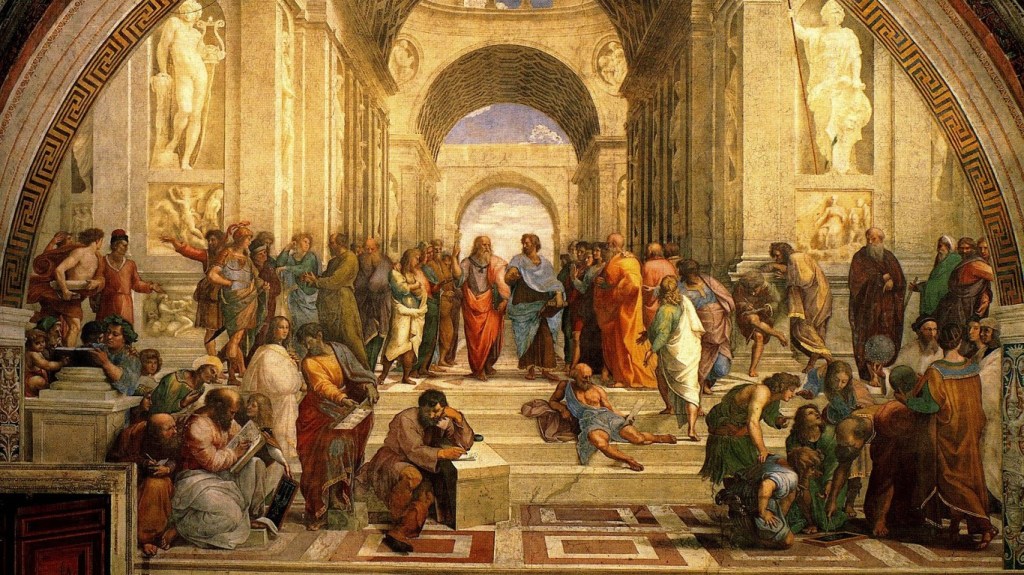
The knee-jerk response to the question of what I learned in college is to list out the individual classes that I took throughout my academic career and lead to my AA, BA, and MBA. Through that lens, I learned College Algebra and Statistics; I learned about Renaissance Art and its historical significance (see “School of Athens” above); I learned Rhetorical Criticism and Crisis Management; and, I learned about Accounting, Finance, Marketing, Operations Management, and International Trade…among many other topics.
The university diploma is a guarantee from the school that I have been academically trained and should be able to demonstrate a competency in the field for which they have certified me. I think there’s more to higher education than the specific deploma that you receive at the end.
The training that you receive is certainly important because it gives you a minimum knowledge base to enter a career field and perform satisfactorily. This is simply your specialty. Regardless of your degree and chosen career field, there are some common learning objectives between the broad spectrum of specialties.
The most important thing that I learned in college, and I think the most important thing that anyone learns, is the process of education. By the process of education, I mean how one goes about acquiring knowledge, distinguishing good information from bad information, and synthesizing it into a useful form.
The process of education is the ability to acquire knowledge, distinguish good information from bad information, and synthesize it into a useful form.
Regardless of what your academic specialty and career field is, you should be able to successfully go through this process over and over again. This is why I think that it is silly to discount when a person from one field speaks on topics in a different field. If they have gone through the process to educate themselves, then there is no reason that we shouldn’t listen to them. Provided, of course, that they have previously displayed that competency.
As a society, we seem to have a bad habit of pigeonholing people based on our personal expectations of them. Conspiracy theories arise when a software developer begins taking a public and proactive approach to combating future viral outbreaks, despite the fact that he was not only correct, but had spent years publicly studying virology and putting plans into action in through the Gates Foundation. Yes, Bill Gates is capable of both creating a strong software brand and sounding the alarm on viral outbreaks.
I have chosen to specialize in Communication for my undergraduate work and Business for my graduate work and I have retained a lot of great information from both fields. But, that does not limit my potential to Communication and Business. I learned the process of education and, thus, can achieve a high-level understanding in any field that I have the time to pursue.
 Christopher Padilla
You must be logged in to post a comment.