Unlock the power of Prospect Theory for marketing success! This game-changing decision-making theory reveals how to craft irresistible messages that resonate with customers. Tap into their natural tendencies, biases, and motivations to boost sales and drive conversions.

Prospect Theory, a groundbreaking decision-making concept, disputes the conventional economic principle of rational choice. Instead, this theory posits that individuals base their decisions on how options are framed instead of solely relying on objective probabilities. As a result, people exhibit diminishing sensitivity towards gains and heightened sensitivity to losses, indicating a stronger aversion to losses than attraction to gains.
Psychologists Daniel Kahneman and Amos Tversky, cognitive psychology experts, introduced Prospect Theory in 1979 through their influential paper in the Econometrica journal, “Prospect Theory: An Analysis of Decision Under Risk.” Their work questioned rational choice, the classical economic theory’s cornerstone. Instead, it offered a fresh perspective on decision-making in uncertain circumstances. This study has since become a cornerstone of behavioral economics.
Rational Choice Theory presumes that individuals make decisions by rationally evaluating the costs and benefits of various options. This theory assumes people possess complete information about alternatives and potential outcomes, enabling them to maximize expected utility. It further postulates that individuals can make consistent, logical decisions regardless of context or information presentation.
However, Prospect Theory challenges these assumptions, revealing that subjective factors like option framing influence people’s decisions, often resulting in irrational choices in the traditional economic sense. In addition, the theory highlights that people tend to evaluate outcomes relative to a reference point rather than objective probabilities, displaying more sensitivity to losses than gains.
Consequently, individuals may make different choices based on how the information is presented, even if the underlying outcomes remain identical. For instance, people might be more inclined to take risks to avoid losses than to chase gains, or social norms or comparable situations may sway them. Prospect Theory offers a novel framework to comprehend decision-making, with significant implications for finance, marketing, and public policy sectors.
For marketers, Prospect Theory provides valuable insights into decision-making processes and factors that drive actions. By understanding the theory’s principles, marketers can design messages and incentives that tap into people’s natural tendencies and biases, like loss aversion, social norm adherence, and reward-seeking. These insights enable marketers to develop more impactful marketing strategies and messages that resonate with target audiences and stimulate conversions.
An actionable approach to leveraging Prospect Theory in your marketing efforts is to employ the concept of ‘loss framing.’ Loss Framing involves presenting the potential consequences of not taking action as a loss rather than a missed gain. By doing so, you tap into the natural loss aversion of your target audience and encourage them to take action to avoid perceived losses. For example, instead of offering a discount for a limited time, frame it as a potential loss by saying, ‘Don’t miss out on saving 20% – offer ends soon!’ This approach makes the message more persuasive and creates a sense of urgency that prompts customers to act quickly.
The bottom line is that Prospect Theory presents a robust framework for deciphering decision-making in uncertain or risky situations. Acknowledging that subjective factors and biases frequently influence people’s decisions, marketers can craft more persuasive messaging and incentives that connect with their target audience. By emphasizing potential losses, using reference points, presenting information clearly and straightforwardly, leveraging social proof, and offering action incentives, marketers can create compelling marketing messages that encourage customers to act. Applying Prospect Theory principles empowers businesses to devise more effective marketing strategies, ultimately driving superior results.
Updated on 4/28/2023 with Grammarly recommendations.
After writing the original post, I’ve come across a great YouTube video from Daniel Kahneman on BigThink! Enjoy!
Further Reading:
Academic Papers
Books
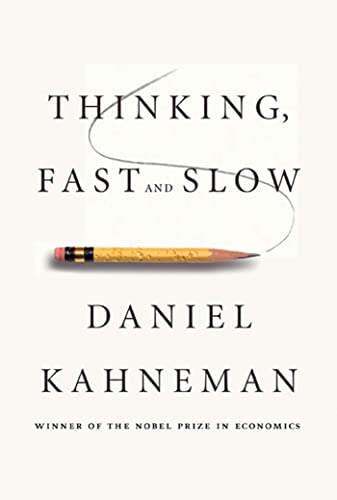
“Thinking, Fast and Slow” by Daniel Kahneman: This essential book delves into human thought processes, exploring the two systems of thought – System 1 (fast, intuitive) and System 2 (slow, deliberate) – and their impact on decision-making. Written by the Nobel Prize-winning co-founder of Prospect Theory, it offers invaluable insights into the biases that influence our choices and is a must-read for understanding and applying Prospect Theory in marketing and other fields.
 Christopher Padilla
You must be logged in to post a comment.